Interest in private investing continues to grow among family offices. For single family offices (SFOs) considering direct private investment (DPI) allocations, this article offers a general framework for evaluating opportunities, comparing risks, and identifying where SFOs may be most comfortable participating.
DPI has deep roots in family wealth. Many fortunes began with an entrepreneur who secured capital to launch the business that created the wealth the SFO manages. Today, family offices can invest directly (as opposed to through a third-party managed fund) in operating companies through private placements, securities offerings that are exempt from public registration with the Securities and Exchange Commission (SEC). These offerings must still comply with the private placement provisions of the Securities Act of 1933 and related SEC regulations, particularly Regulation D, which governs how private securities must be offered, but not the type of security being sold.
Direct investments are used to finance multiple, earlier stages of a company’s development, as well as real estate projects and other types of assets. As the number of U.S. public companies has significantly declined, from over 8000 in 1996 to under 4000 today, private markets have expanded, with family offices placing greater emphasis on direct investing.1 In 2025, family offices completed more than twice as many direct investments globally as in the prior year, according to S&P Global.2
One DPI investment will vary significantly from another, with families able to invest in businesses or projects at different stages, each with its own risk profile, return potential, and diligence requirements.
The chart below illustrates the primary categories where capital allocated to DPI can be deployed. The initial screening phase should first differentiate whether the security being offered falls into a debt or equity bucket. Debt usually provides current income with specific repayment terms, while equity generally offers greater return potential but with higher risk and a much less specific timeline for the return of capital.
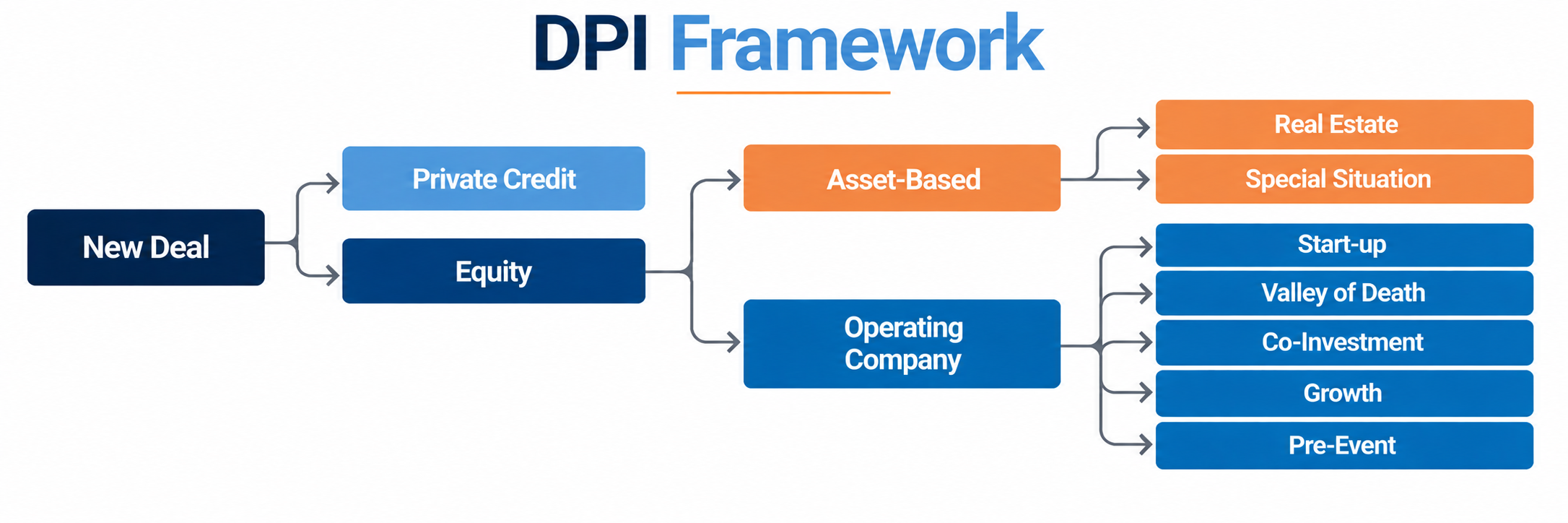
Equity investments can either be in an asset-based security, such as real estate or other asset requiring specialized expertise, or in an operating company. In the latter case, the above categories reflect an operating company’s stage of development as well as other circumstances inherent to the offering, like the presence of well-established investors specializing in this type of investment or when the investment is a “bridge” to a sale of the company or its IPO.
The following describes these categories of DPI, so that SFOs can more consistently and efficiently determine a company’s development stage and the range of investment considerations as they reflect on the family’s risk tolerance, return expectations, and overall objectives.
Investing in Operating Companies
- Startups: Assess the Product, Team, and Market
As one would expect, start-up investing involves the highest investment risk since these businesses do not usually have well-developed products and sales, much less enterprise- sustaining cash flow from operations.
Success in startup investing depends enormously on the strength of the concept, the founders’ capabilities, the company’s competitive advantage, and the business’s addressable market.
Compelling technology generally is not sufficient to result in an attractive ROI. Does the company also have a clear “go to market” strategy and the means to start making progress toward commercial sales? Diligence should assess both the team’s execution capabilities and the size and growth potential of the market.
- The Valley of Death: Progress, but Still Too Early for Many
Companies in the so-called Valley of Death have attracted customers and demonstrated commercial potential, yet they continue to burn cash faster than they generate it AND investment from venture capital funds is still not available… It’s still too early. The challenge is particularly acute for capital-intensive businesses moving from proven technology to commercial production.
Tesla faced this challenge twice in its early history. By the end of 2008, it had less than $500,000 in cash. Elon Musk later said the company came within weeks of failure again during the Model 3 production ramp in 2018.3 New capital helped it survive as progress became visible to investors.
Family offices evaluating these companies should ask: will this financing fund further development, achieve a clear, value-proving commercial milestone, or possibly enable sales growth to a level that results in overall cash-flow-positive financial performance? Are customers returning and margins improving? When institutional investors sit on the sidelines until greater sales have been generated, family offices have a unique opportunity to step in to finance the next stage, provided they are comfortable with the greater risks.
- Co-Investment: Leveraging Prior Investors’ Learning Curve … More “Money at the Table”
This is a growing opportunity for SFOs as the venture community itself becomes more stratified between major AI funds (10 dominate) that have no trouble raising capital for themselves and all other VC funds, which are more challenged in this regard.
Co-investment sits between a blind-pool fund and an independently sourced direct deal. A family office invests alongside an experienced sponsor or fund through a deal-specific vehicle, gaining exposure to a particular company while drawing on the lead investor’s sourcing, diligence, and industry expertise.
North American family offices recently allocated an average of 12% of their private equity portfolios to co-investments, compared with 26% to active direct investments and 15% to passive investments.4
This approach reduces the need to source deals independently or build a business development team. Still, families should understand the sponsor’s investment thesis, valuation, and exit assumptions rather than rely solely on the lead’s judgment.
- Growth Equity: Investing in an Established Track Record
Growth equity appeals to investors seeking companies with customers, an established operating model, a strong pipeline, and, importantly, positive EBITDA. These businesses are raising additional equity to expand, acquire competitors, or enter new markets.
The central question shifts from “Can this business work?” to “How much value can additional capital create, and when?” Families with relevant operating experience may be particularly well positioned to assess that potential.
Cambridge Associates reported that the U.S. Growth Equity Index returned 11.9% in 2025, compared with 7.6% for its U.S. Buyout Index, underscoring growth equity’s distinct role in private markets.5
- Pre-Event Investing: Financing the Last Mile
Pre-event investments target companies approaching their sale to a third party, IPO, or other liquidity event. Investors typically have more information about the business than they would at the startup or early-growth stage. The key uncertainties concern the event itself: the company’s readiness, the likelihood of the event reaching completion, and the valuation.
Pre-event capital can finance the final stage of growth while giving investors negotiated terms that protect them when the exit event is realized (price protection, collateralization, etc.). Underwriting must assess both the underlying business and the probability, timing, and terms of the anticipated event.
Financing Projects and Special Situations
Direct investing extends well beyond operating companies. Family offices can invest in discrete projects involving real estate, infrastructure, energy, and specialized assets such as art or film. Rather than buying a diversified fund, a family can select the asset, location, sponsor, project, and capital structure.
The Family Office Advantage
The strongest case for direct investing may not be higher potential returns alone. It is also an opportunity to pursue investments that institutional investors, such as venture funds, cannot or will not pursue. Family offices can leverage their industry expertise and, in some cases, advance broader community priorities.
Families may bring industry expertise, relationships with entrepreneurs, suppliers, customers, and lenders, and patient capital that extends beyond a private investment fund’s life. Tony Pritzker described his family’s approach: “We had a history of, in our family, buying a bunch of different businesses and helping them to optimize and operate at the best level that they can.”6
Direct investing also carries concentration, governance, and workload risks. Jamie Biddle of Still Pond Capital noted how his branch of the duPont family’s wealth was, earlier on, too concentrated in DuPont and General Motors and, therefore, took aggressive steps to create greater diversification across the direct investment portion of the investment portfolio.7
A Roadmap, Not a Formula
Demand for direct investments is growing across the family office community. At least 37% of SFOs expect to increase direct private equity allocations over the next five years.8 In 2025, private markets represented 29% of the average North American family office portfolio, with direct private equity the most popular private market category for new investment.9
Direct investing spans operating companies, projects, and special asset-based situations, each requiring its own underwriting discipline. The framework presented herein suggests a way to quickly and somewhat simply narrow investment focus on that subset of the DPI world that best complements a given family office’s overall investment objectives.
Footnotes and Sources
[1] U.S. Securities and Exchange Commission (SEC). Annual Report, Fiscal Year 2024, and SEC remarks citing the decline in U.S. listed companies from approximately 8,000 in 1996 to approximately 4,200 by mid-2022. The SEC’s more recent reporting data show approximately 3,600 U.S.-domiciled exchange-listed companies in the four-quarter period ending in 2026.
[2] S&P Global Market Intelligence. “Global Family Office Direct Investments More Than Double in 2025.” April 21, 2026. Reports $12.9 billion across 158 transactions globally in 2025, an increase of 123.3% from 2024.
https://www.spglobal.com/market-intelligence/en/news-insights/articles/2026/4/global-family-office-direct-investments-more-than-double-in-2025-100758195
[3] Tesla. WIRED, “How Elon Musk Turned Tesla Into the Car Company of the Future.” Reports that Tesla had less than $500,000 in cash at the end of 2008. For Musk’s statement that Tesla came within single-digit weeks of failure during the 2018 Model 3 production ramp, see Axios.
https://www.wired.com/2010/09/ff-tesla/
https://www.axios.com/2018/11/26/elon-musk-tesla-death-bleeding-cash
[4] RBC Wealth Management and Campden Wealth. The North America Family Office Report 2024. Source for the reported average private equity portfolio allocations of 12% to co-investments, 26% to active direct investments, and 15% to passive direct investments.
https://www.rbcwealthmanagement.com/assets/wp-content/uploads/documents/campaign/the-north-america-family-office-report-2024.pdf
[5] Cambridge Associates. “U.S. PE/VC Benchmark Commentary: Calendar Year 2025.” July 31, 2026. Reports 2025 returns of 11.9% for the U.S. Growth Equity Index and 7.6% for the U.S. Buyout Index.
https://www.cambridgeassociates.com/insight/us-pe-vc-benchmark-commentary-calendar-year-2025/
[6] Margaret Steen, Family Business Magazine. “‘It’s Really About Getting Good People’: Lessons on Direct Investing From Tony Pritzker.” February 9, 2026. Source for Pritzker’s description of his family’s approach to building and improving businesses.
https://www.familybusinessmagazine.com/family-offices/direct-investing/its-really-about-getting-good-people-lessons-on-direct-investing-from-tony-pritzker/
[7] Margaret Steen, The Family Office Professional. “Jamie Biddle: Avoiding Concentration Risk in Multigenerational Family Offices.” September 14, 2026. Discusses the duPont family’s historical concentration in DuPont and General Motors and the rationale for diversification.
https://thefopro.com/jamie-biddle-avoiding-concentration-risk-in-multigenerational-family-offices/
[8] UBS. Global Family Office Report 2025. Reports that 37% of family offices expect a significant or moderate increase in direct private equity allocations over the next five years. The report separately discusses allocations to private equity funds and funds of funds.
https://www.ubs.com/content/dam/assets/wma/static/documents/ubs-gfo-report.pdf
[9] RBC Wealth Management and Campden Wealth. The North America Family Office Report 2025. Reports that private markets accounted for 29% of the average North American family office portfolio and that direct private equity was the most popular private-market category for new investment.
https://www.rbcwealthmanagement.com/en-us/newsroom/2025-10-16/2025-rbc-and-campden-wealth-report-north-american-family-offices-adapt-to-uncertainty-and-embrace-ai-innovation